MyDetox Liver Detoxification Genetic Test | Overgenes
MyDetox genetic test
Genetic analysis of liver detoxification capacity
MyDetox assesses the genetic markers associated with the liver’s Phase I and Phase II enzymes to determine, on a personalized basis, the capacity to metabolize substances and drugs.
Non-invasiveSaliva sample, painless and suitable for any age
Once in a lifetimeYour genetics don’t change: the analysis is performed only once
20 daysResults available within 20 business days after the sample is received at the lab
Liver detoxification
What is liver detoxification and why does your genetics matter?
Liver detoxification is the liver’s ability to neutralize toxic substances coming from the environment, diet, medications or the body’s own metabolism.
This process takes place in two distinct phases. Individual genetics directly affects the efficiency of the enzymes involved in both phases, which determines how each person breaks down and eliminates toxic substances and drugs.
What is MyDetox for?
Analyze the genetic variants involved in the enzymes that transform toxic substances for elimination
Determine, on a personalized basis, the liver’s capacity in response to food and drugs
Provide useful information to personalize diet and prevent adverse responses
Guide clinical decisions on drug metabolization
Detoxification phases
Two phases, one complete enzymatic system
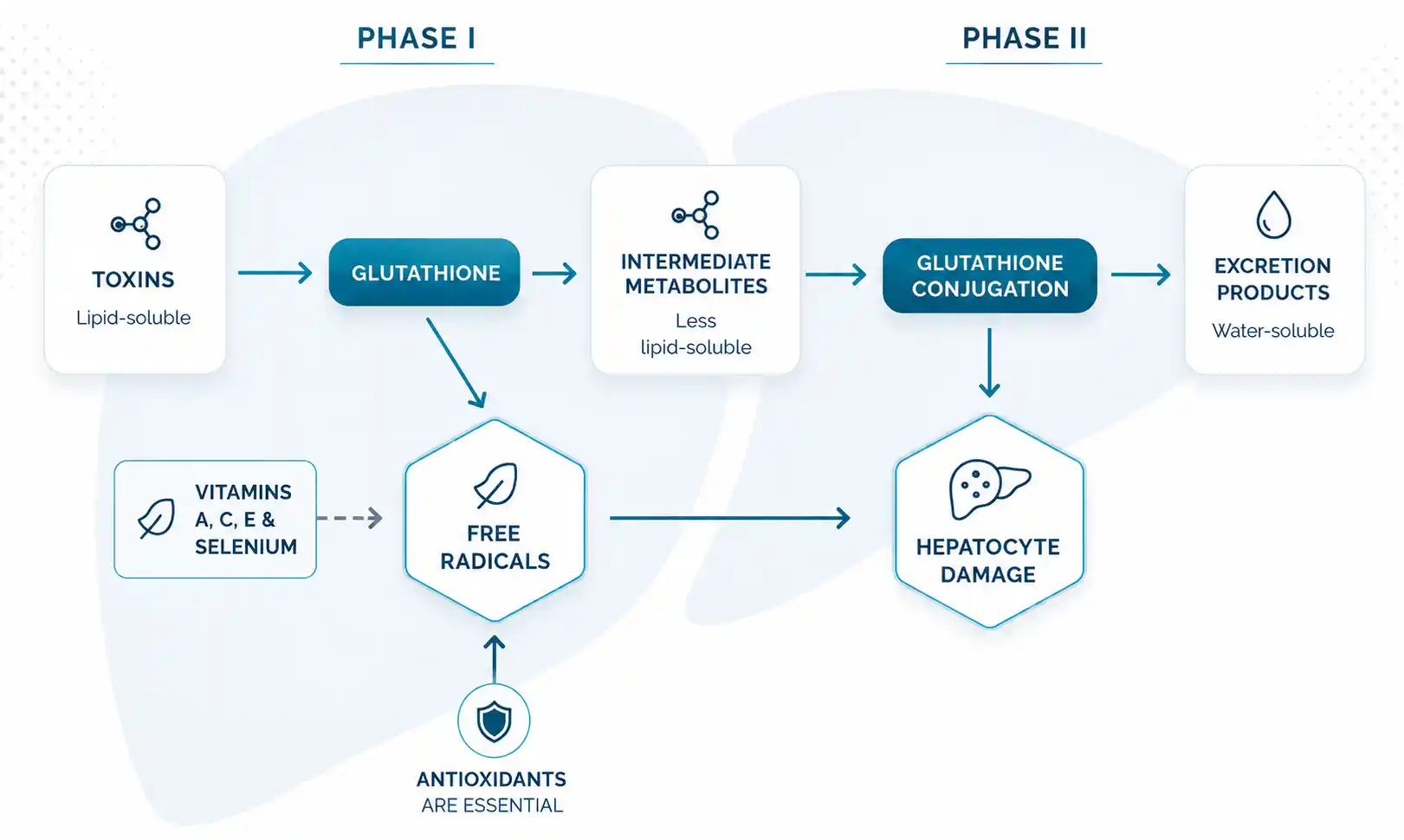
The liver processes toxins in two sequential phases. MyDetox assesses the genetic variants of the enzymes involved in both, determining the individual efficiency of each one.
Phase I · Transformation
Breakdown of toxins
Phase I enzymes — mainly the cytochrome P450 (CYP) family — break down toxic substances through oxidation, reduction and hydrolysis reactions. This phase transforms the original compounds into intermediate metabolites, which can be more reactive and need to be processed by Phase II.
Phase II · Conjugation and elimination
Solubilization and excretion
Phase II enzymes — such as glutathione transferases (GST), UDP-glucuronosyltransferases (UGT), N-acetyltransferases (NAT) and sulfotransferases (SULT) — conjugate the intermediate metabolites with molecules that make them water-soluble, allowing their elimination from the body through urine or bile.
Indication
Who is MyDetox aimed at?
MyDetox is aimed at healthcare professionals who want to understand how their patients metabolize food and medications, with the aim of personalizing diet and preventing adverse drug responses.
Clinical applications
Personalization of diet based on individual detoxification capacity
Prevention of adverse drug reactions
Assessment of the patient’s liver enzymatic efficiency
Support for pharmacological prescription decisions
Identification of slow, normal or rapid metabolizers
+50 genes analyzed
Genes involved in liver detoxification
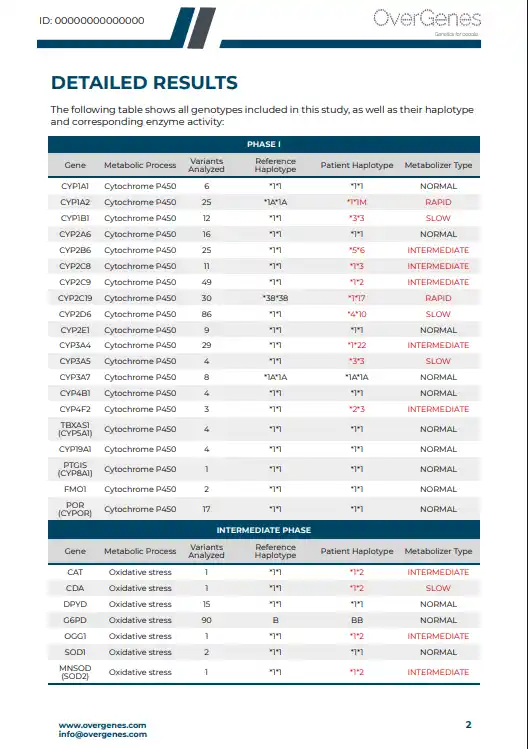
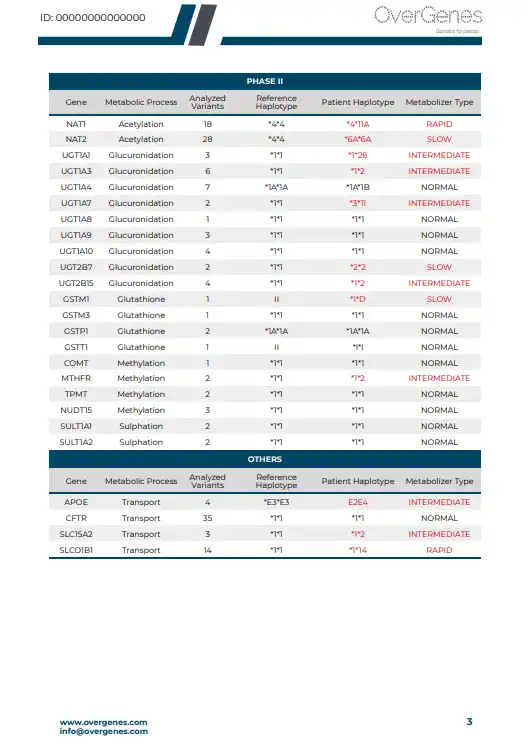
MyDetox analyzes genetic variants of more than 50 genes grouped into four functional blocks: Phase I, Intermediate Phase, Phase II and transport genes.
Phase I · Cytochrome P450
20 genes · Transformation enzymes
CYP1A1
CYP1A2
CYP1B1
CYP2A6
CYP2B6
CYP2C8
CYP2C9
CYP2C19
CYP2D6
CYP2E1
CYP3A4
CYP3A5
CYP3A7
CYP4B1
CYP4F2
TBXAS1 (CYP5A1)
CYP19A1
PTGIS (CYP8A1)
FMO1
POR (CYPOR)
Intermediate Phase
7 genes · Oxidative stress
CAT
CDA
DPYD
G6PD
OGG1
SOD1
MNSOD (SOD2)
Phase II · Conjugation
21 genes · Solubilization and elimination
NAT1 · Acetylation
NAT2 · Acetylation
UGT1A1
UGT1A3
UGT1A4
UGT1A7
UGT1A8
UGT1A9
UGT1A10
UGT2B7
UGT2B15
GSTM1
GSTM3
GSTP1
GSTT1
COMT
MTHFR
TPMT
NUDT15
SULT1A1
SULT1A2
Transport
4 genes · Substance transport
APOE
CFTR
SLC15A2
SLCO1B1
+50genes analyzed involved in liver detoxification
How it works
From DNA to a personalized detoxification profile
A simple, non-invasive process designed for clinical practice.
Sample collection
Saliva sample following the kit instructions. Painless, with no prior preparation required.
Genetic analysis
Variants of more than 50 genes involved in Phase I and Phase II enzymes are analyzed.
Personalized report
Results by gene and by phase, with an indication of individual enzymatic efficiency.
Professional interpretation
The report is interpreted with a doctor or healthcare professional to guide clinical decisions.
MyDetox Report
Genetic liver detoxification profile
The report presents the analysis of each gene assessed, grouped by phase and enzymatic family, with indications on individual metabolic efficiency.
Analysis of variants by gene and their impact on enzymatic function
Grouped by Phase I (transformation) and Phase II (conjugation)
Identification of slow, normal and rapid metabolizers
Relevant information to personalize diet and pharmacological prescription
It is the liver’s ability to neutralize toxic substances from the environment or generated by the body. It takes place in two phases: in Phase I, toxins are broken down by enzymes of the cytochrome P450 family, and in Phase II they are conjugated with molecules that make them water-soluble for elimination.
What does MyDetox analyze?
It analyzes genetic variants of more than 50 genes involved in Phase I and Phase II liver detoxification enzymes. This includes the cytochrome P450 (CYP) family, glutathione transferases (GST), UDP-glucuronosyltransferases (UGT), N-acetyltransferases (NAT), sulfotransferases (SULT) and other genes relevant to transport and cellular protection.
Who is it aimed at?
At healthcare professionals who want to understand how their patients metabolize food and medications, with the aim of personalizing diet and avoiding adverse drug reactions.
What does it mean to be a slow, normal or rapid metabolizer?
Depending on the genetic variants present in each enzyme, a person may metabolize certain substances more slowly, normally, or more rapidly than average. This directly affects the effectiveness and safety of certain medications and the ability to eliminate toxins.
Is a medical prescription needed?
No prescription is needed, but it is recommended that the results be interpreted by a healthcare professional, especially regarding drug metabolization. Genetic information should be integrated with the patient’s clinical history.
Does the test need to be repeated over time?
No. The genetic profile doesn’t change throughout life, so the test is performed only once.
MyDetox · Overgenes
Discover your liver’s detoxification capacity
+50 genes analyzed to determine, on a personalized basis, how your body metabolizes substances, food and drugs.