MyEstrogens genetic test
Female hormonal balance through genetics
MyEstrogens offers a complete view of the role genetics plays in female hormonal balance: estrogen metabolism, hormone receptors and thrombosis risk.
Non-invasiveSaliva sample, painless and suitable for any age
Once in a lifetimeYour genetics don’t change: the analysis is performed only once
20 daysResults available within 20 business days after the sample is received at the lab
Genetics and hormonal health
Why does genetics matter in hormonal balance?
Genetics influences how the body transforms, eliminates and responds to estrogens. It also shapes the efficiency of hormone receptors and the predisposition to thrombotic events associated with hormonal treatments.
MyEstrogens analyzes these three axes to personalize medical care, guide decisions on hormone replacement therapy, and provide key information for the prevention of diseases associated with hormonal imbalance and cardiovascular risk.
What is MyEstrogens for?
- Assess the ability to metabolize and eliminate estrogens
- Learn your hormone receptor profile (ESR1, PGR)
- Assess genetic thrombosis risk before hormonal treatments
- Guide decisions on hormone replacement therapy
- Help prevent diseases associated with hormonal imbalance
Three analysis areas
What MyEstrogens analyzes
The test studies three fundamental axes of female hormonal health, each with direct clinical implications.
Area 1
Estrogen metabolism
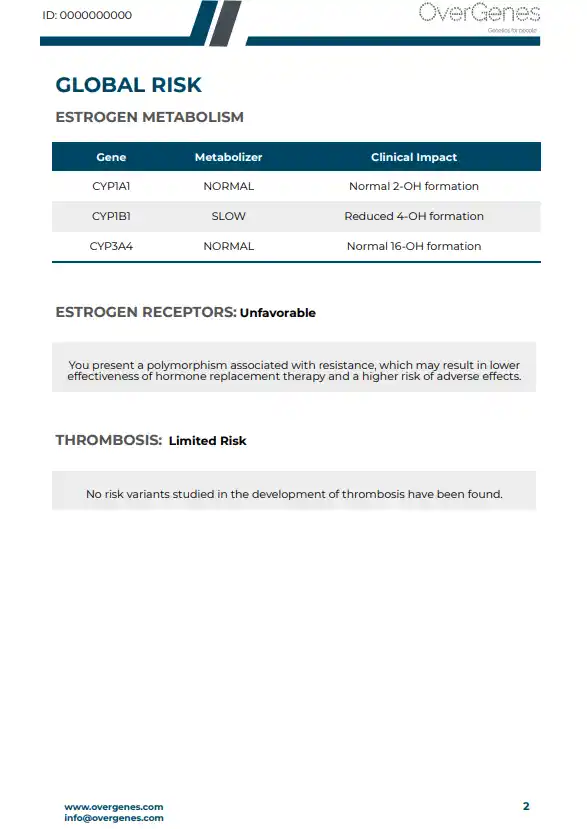
Identifies genes that influence the body’s ability to transform and eliminate estrogens, a key process for maintaining adequate hormone levels and reducing the accumulation of harmful metabolites.
- 2-OH-estrogens: considered protective, lower estrogenic activity
- 4-OH-estrogens: potentially harmful, can form free radicals
- 16-OH-estrogens: more potent estrogenic activity, proliferative effect
Area 2
Estrogen receptors
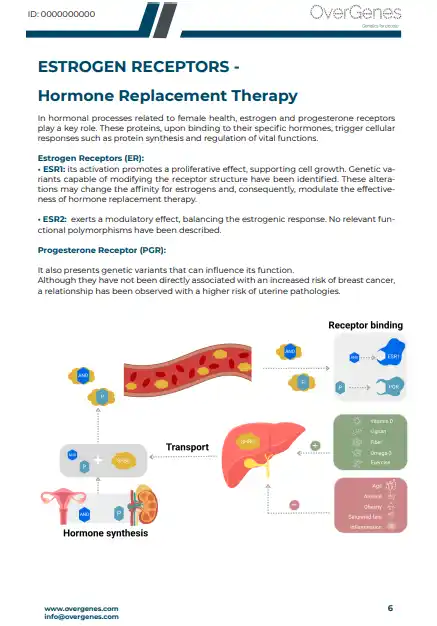
Assesses genes that mediate the action of estrogens and progesterone in tissues. Variations in the receptors can shape the effectiveness of hormonal therapies and the body’s response.
- ESR1: proliferative receptor, variants that modify estrogen affinity
- PGR: progesterone receptor, variants that influence hormonal regulation
- Combined ESR1+PGR profile to classify hormonal response
Area 3
Thrombosis risk
Includes genes related to thrombosis, a key aspect to consider in women assessing hormonal treatments. Assesses monogenic and polygenic risk.
- High-impact genes: MPL, PROS1, SERPINC1, ACVRL1, ENG
- Polygenic risk: combined analysis of multiple variants
- Classification: normal, moderate or elevated risk
Genes analyzed
Complete hormonal genetic profile
MyEstrogens analyzes genes involved in the three areas of female hormonal balance: metabolism, receptors and coagulation.
Estrogen metabolism
12 genes · Phase I and Phase II
- CYP17A1
- CYP19A1
- CYP1A1
- CYP1B1
- CYP3A4
- COMT
- NQO1
- SULT1A1
- GSTM1
- GSTT1
- SOD2
- MTHFR
Hormone receptors
2 genes · Estrogen and progesterone response
- ESR1 (estrogen receptor)
- PGR (progesterone receptor)
Thrombosis risk
5 monogenic genes + polygenic risk
- MPL
- PROS1
- SERPINC1
- ACVRL1
- ENG
- + polygenic analysis of ~70 additional variants
Indication
Who is MyEstrogens aimed at?
At women who want to understand how their genetics influences their hormonal balance, and at healthcare professionals who want to integrate this information into clinical practice to personalize hormonal care.
Clinical application contexts
- Pre-assessment for hormone replacement therapy (HRT)
- Menopause and perimenopause
- Amenorrhea and polycystic ovary syndrome (PCOS)
- Fertility and reproductive medicine
- Cardiovascular prevention in a hormonal context
- Gynecology, endocrinology and functional medicine
How it works
From DNA to more informed hormonal decisions
Sample collection
Saliva sample following the kit instructions. Painless, with no prior preparation required.
Genetic analysis
Variants in estrogen metabolism, hormone receptor and thrombosis risk genes are analyzed.
Personalized report
Results by area: metabolism, receptors and thrombosis, with a combined ESR1+PGR profile.
Clinical application
The information helps guide decisions on hormonal therapy, prevention and lifestyle.
MyEstrogens Report
Your genetic hormonal profile
The report presents the complete analysis of estrogen metabolism, hormone receptors and thrombosis risk, with guiding clinical interpretation.
- Metabolizer type by gene (normal, intermediate, slow, fast)
- Combined ESR1+PGR profile with interpretation for HRT, fertility and menopause
- Thrombosis risk: monogenic and polygenic
- Nutritional and lifestyle recommendations by process
Frequently asked questions
Frequently asked questions about MyEstrogens
What does MyEstrogens analyze?
It analyzes three fundamental areas of female hormonal health: estrogen metabolism (how your body transforms and eliminates estrogens), hormone receptors (ESR1 and PGR, which mediate the action of estrogens and progesterone in tissues) and genetic thrombosis risk (monogenic and polygenic).
Why does it include thrombosis analysis?
Hormonal treatments (such as hormone replacement therapy or contraceptives) can increase the risk of thrombosis in women with a genetic predisposition. MyEstrogens assesses this risk so it can be taken into account before starting any hormonal treatment.
What are the 2-OH, 4-OH and 16-OH metabolites?
These are the main products of estrogen metabolism. 2-OH-estrogens are considered protective. 4-OH-estrogens are potentially harmful if not properly methylated, as they can generate free radicals and damage DNA. 16-OH-estrogens have greater estrogenic activity and a proliferative effect that can be unfavorable in excess.
Who is it aimed at?
At women who want to understand their hormonal genetic profile, and at healthcare professionals (gynecology, endocrinology, reproductive medicine, functional medicine) who want to personalize hormonal care with genetic information.
Is it useful for assessing hormone replacement therapy?
Yes. The combined ESR1+PGR receptor profile makes it possible to classify the expected hormonal response, and the thrombosis analysis provides information on the associated cardiovascular risk. No genetic combination alone contraindicates HRT, but in less favorable profiles it is advisable to adapt the treatment on an individualized basis.
Does the test need to be repeated?
No. The genetic profile doesn’t change throughout life.
Does it replace a gynecological consultation?
No. It provides complementary genetic information that should be interpreted by a healthcare professional together with hormonal lab tests, clinical history and each patient’s individual context.
MyEstrogens · Overgenes
Discover your genetic hormonal profile
Estrogen metabolism, hormone receptors and thrombosis risk analyzed to guide more informed decisions about your hormonal health.